
Board of Governors of the Federal Reserve System
International Finance Discussion Papers
Number 836, August 2005 --- Screen Reader
Version*
Estimating Elasticities for U.S. Trade in Services
NOTE: International Finance Discussion Papers are preliminary materials circulated to stimulate discussion and critical comment. References in publications to International Finance Discussion Papers (other than an acknowledgment that the writer has had access to unpublished material) should be cleared with the author or authors. Recent IFDPs are available on the Web at http://www.federalreserve.gov/pubs/ifdp/. This paper can be downloaded without charge from the Social Science Research Network electronic library at http://www.ssrn.com/.
Abstract:
Explanations of the persistent deficit in U.S. net exports of goods rest on macroeconomic developments and an asymmetry in elasticities: the income elasticity for imports being larger than the income elasticity for exports. Such macroeconomic developments are not applicable to the equally persistent surplus in U.S. net exports of services unless the income elasticities for services exhibit the reversed asymmetry. There have been surprisingly few attempts to demonstrate the existence of this reversed asymmetry, a task that I undertake here. Specifically, I estimate income and price elasticities for U.S. trade in services and evaluate the importance of simultaneity and aggregation biases. The analysis reveals two findings. First, the income elasticity for U.S. exports of services is significantly greater than the income elasticity for U.S. imports of services. Second, disaggregation is the most important aspect of econometric design in this area.
Keywords: U.S. service trade, external imbalances, income elasticity, price elasticity, general-to-specific, automated specification.
JEL classification: C52, C63, C87, F17, F32
1 Introduction and Conclusion
Explanations of the persistent deficit in U.S. net exports of goods rest on macroeconomic developments and an asymmetry in elasticities: the income elasticity for imports being larger than the income elasticity for exports.1 Those explanations cannot, however, account for the equally persistent surplus in net exports of services unless the elasticities for service trade exhibit the reversed asymmetry: the income elasticity for exports being larger than the income elasticity for imports. This reversed asymmetry is central to reconciling macroeconomic developments with the divergence of U.S. external balances (figure 1) but there have been surprisingly few attempts to document its existence.2 Finding out whether this reversed asymmetry is supported by the data is what I do here.
Interest in estimating elasticities for trade in services extends beyond questions of external imbalances. Indeed, services and goods differ in nature and thus the available elasticity estimates for trade in goods need not be relevant for understanding the behavior of trade in services.3 For example, the production and delivery of services coincide and thus previous work characterizing dynamic adjustments for trade in goods need not extend to trade in services. Further, the scope for differentiation in services is greater than in goods (e.g., insurance policies versus oil), a feature that enhances the scope for price discrimination in services. Econometrically, differentiation means that data disaggregation and price endogeneity are relevant for estimating elasticities for trade in services.
Accordingly, I estimate income and price elasticities for exports and imports of four categories: travel, fares, transportation, and other private services. To assess aggregation biases, I compare these elasticities to the ones associated with aggregate services. I assess simultaneity biases by comparing estimates from three estimation methods: ordinary least squares, instrumental variables, and full information maximum likelihood. For modeling dynamic adjustments, I implement a General-to-Specific strategy based on the automated search algorithm developed by Krolzig and Hendry (2001). A key feature of their algorithm is that it adjusts the significance levels of statistical tests to recognize the joint nature of model specification and parameter estimation.
Two conclusions emerge from this investigation. First, the income elasticity for U.S. exports of services is significantly greater than the income elasticity for U.S. imports of services. This reversed asymmetry means that one can reconcile macroeconomic developments with the divergence in U.S. external balances. Second, disaggregation is central to this reversed asymmetry: No disaggregation means no reversed elasticity asymmetry, regardless of estimation method and specification technique.
2 External Balances and Trade Elasticities
The framework currently used to explain external imbalances assumes that foreign and domestic products are imperfect substitutes and that income and real exchange rates are the proximate determinants of international trade. With these assumptions, net exports of goods, NXg, are expressed as

|
(1) |
where X denotes exports of goods; Y*
denotes foreign real income; Q denotes
the real effective value of the dollar; Mg denotes
imports of goods; and Y denotes U.S. real income. To quantify the
importance of these variables on net exports, the change of
NX
denotes exports of goods; Y*
denotes foreign real income; Q denotes
the real effective value of the dollar; Mg denotes
imports of goods; and Y denotes U.S. real income. To quantify the
importance of these variables on net exports, the change of
NX is expressed in terms of trade
elasticities and growth rates:
is expressed in terms of trade
elasticities and growth rates:

|
(2) |
where the symbol ' ' stands for growth rate,
 is the income elasticity for
exports,
is the income elasticity for
exports,  is the price elasticity of
exports,
is the price elasticity of
exports,  is the income elasticity for
imports, and
is the income elasticity for
imports, and  is the price elasticity for imports.
One can simplify equation (2) further by recognizing two
properties of the data. First, since 1970, the average rate of
change of the real effective value of the dollar has been close to
zero (figure 1) and thus I set  . Second,
prior to 1976, net exports of goods were balanced meaning that
. Second,
prior to 1976, net exports of goods were balanced meaning that  . 4 With these
properties, equation (2) becomes
. 4 With these
properties, equation (2) becomes
![\begin{displaymath} dNX_t^g =X_{t-1}^g \cdot \left[ {\left( {\eta _x^g \cdot \mathord{\buildrel{\lower3pt\hbox{$\scriptscriptstyle\frown$}}\over {Y}} _t^\ast -\eta _m^g \cdot \mathord{\buildrel{\lower3pt\hbox{$\scriptscriptstyle\frown$}}\over {Y}} _t } \right)} \right] \end{displaymath}](imgeq3.gif)
|
(3) |
Equation (3) has implications for the pattern of income
elasticities. Specifically, as figure 1 shows, growth in the rest of
the world has been, on average, quite close to that of the United
States.5 Thus reconciling  with dNXg < 0 implies that < , an asymmetry with ample empirical support.6
Though coherent, this framework cannot account for the
persistent surplus in net exports of services. Indeed, if one uses
real income and real exchange rates to explain services, then the
change in net exports of services,  , can
be written as
, can
be written as
![\begin{displaymath} dNX_t^s =X_{t-1}^s \cdot \left[ {\left( {\eta _x \cdot \mathord{\buildrel{\lower3pt\hbox{$\scriptscriptstyle\frown$}}\over {Y}} _t^\ast -\eta _m \cdot \mathord{\buildrel{\lower3pt\hbox{$\scriptscriptstyle\frown$}}\over {Y}} _t } \right)} \right] \end{displaymath}](imgeq4.gif)
|
(4) |
where Xs denotes exports of services;
ηx is the income elasticity for exports
of services; and ηm is the income elasticity for
imports of services. Thus reconciling with dNXs > 0 implies that
 . The question I address
is whether the data support this reversed asymmetry.
. The question I address
is whether the data support this reversed asymmetry.
3 Econometric Design
The empirical formulation rests on the imperfect substitute model in which movements in the logarithm of trade are explained in terms of movements in the logarithms of income and relative prices.7 To allow for delayed responses, induced perhaps by service contracts, I use an autoregressive distributed lag formulation.
3.1 Specification
The specification for exports of the ith type of services is

|
(5) |
where xi denotes real exports of services of the ith category;
Pxi denotes the dollar export price of the ith category of
services; P* denotes the foreign price deflator
expressed in U.S. dollars; 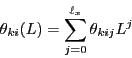 (k > 0) where L is the lag operator. The long-run income elasticity is
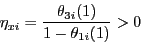
|
(6) |
and the long-run price elasticity is 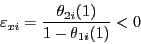 .
.
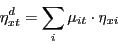
Having estimated the long-run elasticities across export categories, I aggregate them into an elasticity for aggregate exports. For the income elasticity, the aggregate is
|
(7) |
where ηit is the export share of the ith type of service exports and the superscript 'd ' denotes an aggregate elasticity based on disaggregated equations; I construct a comparable aggregate for the price elasticities.
As an alternative to equation (7), I estimate elasticities for aggregate exports as such:

|
(8) |
where x denotes aggregate exports of services in real terms, Pxt
denotes the dollar export price of aggregate services, and 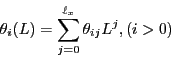 . The long-run income elasticity is
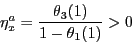
|
(9) |
and the associated long-run price elasticity is 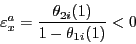 ; the superscript 'a ' denotes an aggregate elasticity based on an aggregate equation. With two
alternative estimates of the aggregate income elasticity, I assess
the importance of aggregation bias by testing whether
; the superscript 'a ' denotes an aggregate elasticity based on an aggregate equation. With two
alternative estimates of the aggregate income elasticity, I assess
the importance of aggregation bias by testing whether  is significantly different from
  ; I apply the same test to the
price elasticities.
; I apply the same test to the
price elasticities.
The specification for imports of the ith type of services is

|
(10) |
where mi denotes real imports of the ith type of service; Pmi
denotes the dollar import price of services; P denotes the U.S. GDP deflator; 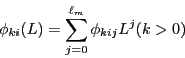 . The long-run income elasticity is
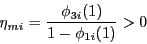
|
(11) |
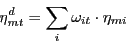
and the long-run price elasticity is 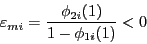 . The aggregate of
the income elasticities is
. The aggregate of
the income elasticities is
|
(12) |
where ωit is the import share of the ith type of service imports; I construct a comparable aggregate for the price elasticities.
The corresponding specification for aggregate imports of services is

|
(13) |
where m represents aggregate imports of services in real terms; Pmt denotes the dollar import price of aggregate services; and φi(L) is a polynomial in the lag operator L. The long-run income elasticity of aggregate imports is
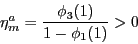
|
(14) |
and the long-run price elasticity is 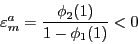 . Again, I assess the magnitude of the aggregation bias in the estimated income elasticity by testing
whether
. Again, I assess the magnitude of the aggregation bias in the estimated income elasticity by testing
whether  is significantly different from
  ; I apply the same test to
the aggregate of price elasticities.
; I apply the same test to
the aggregate of price elasticities.
3.2 Estimation: Automated specification
The automated-specification algorithm developed by Hendry and Krolzig (2001) offers three advantages relative to implementing a General-to-Specific strategy interactively.8 First, their algorithm considers all of the statistically valid specifications. Second, the algorithm adjusts the significance levels for statistical tests to recognize the joint nature of model specification and parameter estimation. Finally, each step in the process of automated search can be replicated at once.
The algorithm combines least squares with a selection strategy that is implemented in four stages:9
- Estimate the parameters of a general formulation -- equation (5) for example -- and test for congruency (white-noise residuals).
- Implement multiple "simplification paths" simultaneously. One simplification path could get started by excluding the least significant variable whereas another simplification path could get initiated by excluding a block of variables that are jointly insignificant.
- Test whether the specification from a simplification path is congruent. If it is, then implement another round of simplifications and re-test for congruency; continue this process until the specification violates congruency. In that case, the algorithm selects the immediately prior specification and labels it Final model.
- Collect the Final models from all simplification paths and apply encompassing tests to them. The specification that encompasses all others becomes the Specific model. If there is no single encompassing model, then the algorithm forms a "union" model using the variables from all of the Final models and re-starts the specification search from step (2). If this strategy fails to yield a single Specific model, then the algorithm applies three information criteria (Akaike, Schwarz, and Hannan-Quinn) to the Final models and selects the one that minimizes all these criteria; that model becomes the Specific model.10 Otherwise, the algorithm fails to find a Specific model.
I implement these steps following two automated strategies. In the first one, labeled Liberal, the cost of excluding a relevant variable is deemed higher than the cost of retaining an irrelevant variable; thus the algorithm errs on the side of retaining additional variables in the specification. In the second one, labeled Conservative, the cost of including irrelevant variables is deemed higher than the cost of excluding relevant variables; thus the algorithm errs on the side of excluding relevant variables.
3.3 Data Sources and Definitions
I disaggregate data for services into their four components: travel, fares, transportation, and other private services.11 Data for travel exports are receipts from foreign residents on food, lodging, recreation, gifts, and local transportation; travel imports are payments to foreign residents on the same groupings. Data for fare exports are expenditures by foreign travelers to U.S. carriers; fare imports are payments by U.S. residents to foreign carriers and foreign cruise operators. Data for transportation exports are receipts from foreign residents on freight services for ocean, air, rail (Canada and Mexico); data for transportation imports are expenses by shippers in foreign ports and payments to foreign residents for vessel charters, aircraft rentals, and freight-car rentals. Data for exports of other private services are receipts for education, financial services, insurance, telecommunications, business, and other.12 Data for imports of other private services are payments by U.S. residents to foreign residents on the same six categories.
I measure the relative import price of the ith category as  where Pmi is the chain weighted price index for imports of the ith category and P is
the chain weighted price for GDP; the data come from the BEA. I
measure the relative price of exports of the ith category as
where Pmi is the chain weighted price index for imports of the ith category and P is
the chain weighted price for GDP; the data come from the BEA. I
measure the relative price of exports of the ith category as  where Pxit is BEA's chain
weighted export price index for the ith category of services, and P* is the foreign deflator
in dollars. I measure this deflator as
where Pxit is BEA's chain
weighted export price index for the ith category of services, and P* is the foreign deflator
in dollars. I measure this deflator as

|
(15) |
where E$/j is the nominal, bilateral rate of the dollar against the jth currency; Pj is the deflator for the jth country in local currency; γjt is the time-varying share of country j in U.S. bilateral exports of services to 36 countries.13
I measure U.S. GDP with BEA's chain weighted measure of GDP in constant prices; I measure foreign real GDP as
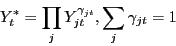
|
(16) |
where Yj is an index of the real GDP of the jth country.
For disaggregation to matter, relative prices should exhibit different trends and trade shares should change in relative importance. Figure 2 shows that these conditions are met for U.S. trade in services. For example, the relative price for imports of other private services declines steadily whereas the relative prices for imports of fares rises steadily. Further, travel exports had, until 1996, the largest share of total exports of services, exceeding 30 percent. Since then, exports of other private services have become the category with the largest share: nearly 45 percent in 2001. The counterpart to this increase is the decline in the export share of other transportation services: from 20 percent to 10 percent.
4 Estimation Results
Using quarterly observations from 1987 to 2001, I obtain elasticity estimates for the general and specific formulations (liberal and conservative). To address the question of how "general is the general model," I use alternative general models that differ solely in their lag lengths: 4, 6, and 8 quarters. For each specification, I test for congruency (residuals exhibiting normality, serial independence, and homoskedasticity). To explore the role of estimation methods, I use ordinary least squares (OLS), instrumental variables (IV), and Johansen's
full information maximum likelihood (FIML) procedure.14
Table 1 reports OLS and IV estimates for selected specifications.15 Specifically, for each estimator and search strategy, I select the estimates from the congruent specification with the smallest standard error of the regression; the appendix reports detailed results for each specification.16 The results reveal three findings of interest. First, estimated elasticities vary greatly across types of services. For example, the IV estimates of the income elasticity for imports range from 0.4 (significant) for transportation to 2.5 (significant) for other private services; the corresponding price elasticities range from zero for transportation to -2.1 (significant) for other private services; the dispersion of estimates across categories is robust to changes in econometric design. Second, for a given service category, the estimated income elasticity is robust to changes in econometric design. This robustness extends to the income elasticity of aggregate imports but not to the income elasticity of aggregate exports. Third, with the exception of travel services, estimated price elasticities are quite sensitive to changes in econometric design. For travel, the price elasticity for exports ranges from -0.7 to -0.8, both significant; the price elasticity for travel imports ranges from -1.3 to -1.5, both significant.
4.1 Gains from Automation
A complete assessment of the gains from pursuing automated specification involves replicating previous work not based on automation, a task that is beyond this paper. Nevertheless, an interesting question is whether the absence of automation yields an empirical model that is consistent with theory. In the context of this paper, the question is whether the estimates from the general specification are consistent with the predictions from the imperfect-substitute model. For aggregate exports, the IV estimates of the general model exhibit an income elasticity of zero whereas estimation based on automated search yields an income elasticity greater than one (table 1). For exports of other private services, the only instances of negative price elasticities involve automated search: without it, the results would not support the imperfect substitute model.
Estimates for travel appear, however, invariant to the use of automation. Specifically, as shown in table A-10 of the appendix, the long-run income elasticity for travel imports is 1.1 whereas the associated long-run price elasticity varies from -1.3 to -1.5, a narrow range. One possible explanation for this seemingly irrelevant role of automation is my focus on long-run elasticities at the expense of other properties such as the nature of dynamic adjustments. To this end, I study how the elasticities' cumulative lag distributions change in response to a change in the specification strategy. An elasticity's cumulative lag distribution is the ratio between the value the elasticity takes q quarters into an adjustment process and the value this elasticity takes in the long run.17 A ratio of two after q quarters, for example, indicates that the elasticity estimate after q quarters is twice as large as the value it will have in the long run.
Figure 3 shows the cumulative lag distributions for travel imports when the general model has eight lags.18 The results reveal that, in the absence of automated search, the dynamic adjustment has large and frequent oscillations. For example, the cumulative lag distribution for the income elasticity has a value of 2.5 after five quarters followed by a value of 0.2 after eight quarters. Such large oscillations are, however, dampened considerably using automated specification. The figure also reveals that reliance on automated search shortens the adjustment delay. For example, the estimates from the general formulation suggest that reaching the long-run income elasticity takes more than 40 quarters whereas the estimated delay from a conservative search strategy is ten quarters.
Overall, relying on a general model with no (automated) simplification has two drawbacks for explaining trade in services. First, the elasticity estimates do not support the imperfect-substitute model. Second, the dynamic adjustment for travel imports is implausibly slow.
4.2 Gains from Full Information Estimation
Table 2 compares the FIML estimates to those of table 1.19 From an econometric standpoint, the most significant result is that the difference between IV and OLS estimates is negligible when compared to the difference between IV and FIML estimates. In other words, just using IV estimation suggests that simultaneity biases are small when they are not. From an economic standpoint, the most important result is that the FIML estimates for the income elasticities of aggregate equations do not exhibit a reversed asymmetry: 1.3 for exports and 1.6 for imports. This finding implies that either the imperfect-substitute model is inconsistent with the surplus in net exports of services or that aggregation biases conceal a reversed asymmetry in income elasticities.
4.3 Gains from Disaggregation
Table 2 suggests that aggregation biases could indeed be
concealing a reversed asymmetry in income elasticities: the
estimates for disaggregated exports are generally greater than the
corresponding income elasticities for imports.20 To explore this possibility further, figure 4 displays
the 95 percent confidence bands for the income elasticity based on
the disaggregated estimates ( ,
,  ) and based on the aggregate
estimates (
) and based on the aggregate
estimates ( ,
,  ). The most important finding is
that, based on the disaggregate estimates, the income elasticity
for aggregate exports is significantly higher than the income
elasticity for aggregate imports. Furthermore, the existence and
statistical significance of this reversed asymmetry are not sensitive to the estimation method. For example, the FIML
estimates of and are 2.5 and 1.1, respectively, quite comparable to the reversed
asymmetry for the OLS and IV estimates. The second important finding
is that the elasticity estimates based on the aggregate equation do
not exhibit such a reversal, regardless of estimation method. In
other words, estimating the parameters of equations for aggregate
service yields empirical models that, though supported by tests of
statistical adequacy, cannot reconcile macroeconomic developments
with the divergence in U.S. external balances. Overall, then,
disaggregation is central to accounting for the divergence in the
U.S. external balances with the imperfect substitute model.
). The most important finding is
that, based on the disaggregate estimates, the income elasticity
for aggregate exports is significantly higher than the income
elasticity for aggregate imports. Furthermore, the existence and
statistical significance of this reversed asymmetry are not sensitive to the estimation method. For example, the FIML
estimates of and are 2.5 and 1.1, respectively, quite comparable to the reversed
asymmetry for the OLS and IV estimates. The second important finding
is that the elasticity estimates based on the aggregate equation do
not exhibit such a reversal, regardless of estimation method. In
other words, estimating the parameters of equations for aggregate
service yields empirical models that, though supported by tests of
statistical adequacy, cannot reconcile macroeconomic developments
with the divergence in U.S. external balances. Overall, then,
disaggregation is central to accounting for the divergence in the
U.S. external balances with the imperfect substitute model.
References
Bryant, R., G. Holtham, and P. Hooper, 1988, External deficits and the Dollar, Washington, DC: Brookings Institution.
Burger, A. (ed.), 1989, U.S. Trade deficit: Causes, Consequences, and Cures, Boston, MA: Kluwer Academic Press.
Deardorff, A., S. Hymans, R. Stern, and C. Xiang, 2001, "Forecasting U.S. Trade in Services," in R. Stern, ed., Services in the International Economy: Measurement and Modeling, Sector and Country Studies, and Issues in the WTO Services Negotiations, Ann Arbor: University of Michigan Press.
Goldstein, M. and M. Khan, 1985, "Income and Price Effects in Foreign Trade," in R. Jones and P. Kenen (eds.), Handbook of International Economics, Amsterdam: North-Holland.
Granger, C. and D. H. Hendry, 2004, "A Dialogue Concerning a New Instrument for Econometric Modeling," Econometric Theory, forthcoming.
Hendry, D. F. and J. Doornik, 1999, Empirical Econometric Modelling Using PcGive, London: Timberlake.
Hendry, D. F. and H. Krolzig, 2001, Automatic Econometric Model Selection Using PcGets, London: Timberlake.
Hendry, D. F. and H. Krolzig, 2003, "New Developments in Automatic General-to-specific Modeling," in B. Stigum (ed.), Econometrics and the Philosophy of Economics, Princeton: Princeton University Press.
Houthakker, H. and S. Magee, 1969, "Income and Price Elasticities in World Trade," Review of Economics and Statistics, 51, 111-125.
Johansen, S., 1988, "Statistical Analysis of Cointegration Vectors," Journal of Economic Dynamics & Control, 12, 231-254.
Kimura, F. and H. Lee, 2004, "The Gravity Equation in International Trade in Services," Kangwon National University, mimeo.
Mann, C., 1999, Is the U.S. Trade deficit Sustainable? Washington DC: Institute for International Economics.
Mann, C., 2004, "The US Current Account, New Economy Services, and Implications for Sustainability," Review of International Economics, 12, 262-276.
Marquez, J., 2002, Estimating Trade Elasticities, Dordrecht: Kluwer Academic Publishers.
Mirza, D. and G. Nicoletti, 2004, "Is there Something Special About Trade in Services?" OECD, mimeo.
Phillips, P., 2004, "Automated Discovery in Econometrics," Cowles Foundation Discussion Paper No. 1469, New Haven, Yale University.
Reeve, T., 2001, "Trade in Services," Federal Reserve Board, mimeo.
van Welsum, D., 2003, "International Trade in Services: Issues and Concepts," Birkbeck College London, mimeo.
Figure 1: U.S. External Balances, Incomes, and the Real Exchange Rate
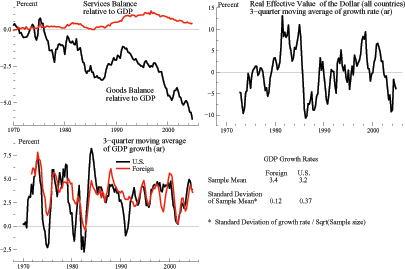
GDP Growth Rates
| Statistic | Foreign | U.S. |
|---|---|---|
| Sample Mean | 3.4 | 3.2 |
| Standard Deviation of Sample Mean* | 0.12 | 0.37 |
* Standard Deviation of growth rate / Sqrt (Sample size).
Figure 2: Relative Prices and Trade Shares for U.S. Trade in Services
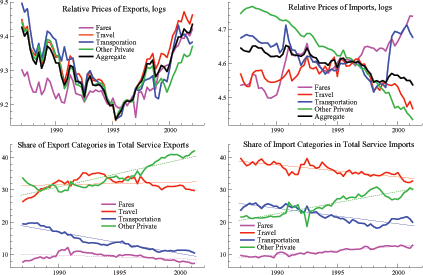
Figure 3: Cumulative Lag Distributions for OLS Elasticities of Travel Imports - 8 lags
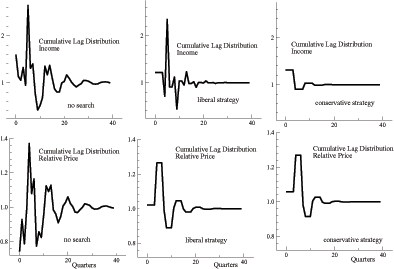
Figure 4: Income Elasticity for Aggregate Services-Sensitivity to Estimation Method
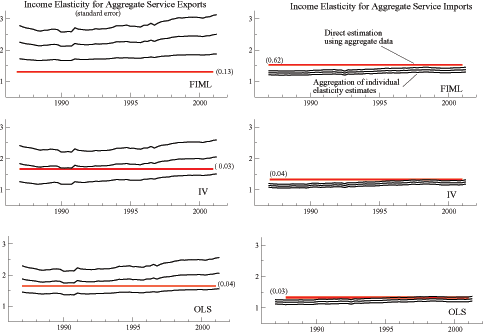
Table 1: Long-run Elasticities for Trade in Services Sensitivity to Single-Equation Estimation Method Selected Specificationsa - Panel A: Income Elasticity
| Category | Exports: OLS: Generalb | Exports: OLS: Specificc | Exports: IV: General | Exports: IV: Specific | Imports: OLS: General | Imports: OLS: Specific | Imports: IV: General | Imports: IV: Specific |
|---|---|---|---|---|---|---|---|---|
| Other Private | 3.23* | 3.12* | 3.26* | 3.20* | 2.26 | 1.54* | 2.18 | 1.50* |
| Fares | 0.40 | 0.59 | 0.10 | 0.00 | 2.12* | 2.36* | 2.12* | 2.47* |
| Transportation | 0.92* | 0.99* | 1.12* | 0.86* | 0.73 | 0.65* | 0.73* | 0.36* |
| Travel | 1.48* | 1.30* | 1.12* | 1.32* | 1.07* | 1.08* | 1.09* | 1.09* |
| Aggregate Trade | 1.29* | 1.67* | 0.00 | 1.69* | 1.47* | 1.37* | 1.37* | 1.36* |
Table 1: Long-run Elasticities for Trade in Services Sensitivity to Single-Equation Estimation Method Selected Specificationsa - Panel B: Price Elasticity
| Category | Exports: OLS: General |
Exports: OLS: Specific |
Exports: IV: General |
Exports: IV: Specific |
Imports: OLS: General |
Imports: OLS: Specific |
Imports: IV: General |
Imports: IV: Specific |
|---|---|---|---|---|---|---|---|---|
| Other Private | +0.48 | -1.08* | +0.35 | -1.14* | -1.31 | -2.18* | -1.06 | -2.10* |
| Fares | -1.07 | +0.01 | -2.02* | +0.32 | -0.62* | -1.37* | -0.62 | -1.53* |
| Transportation | -0.12 | -0.17* | -0.06 | -0.09* | +0.80 | -0.53* | +0.80 | 0.00 |
| Travel | -0.68* | -0.76* | -0.81* | -0.77* | -1.40* | -1.26* | -1.43* | -1.29* |
| Aggregate Trade | -0.50 | -0.26* | -1.12* | -0.27* | -1.10* | -1.60* | -1.62* | -1.57* |
a Selection criteria: For the General
formulation, with either OLS or IV, there are three candidates that
differ in the number of lags; I report the estimates for the
specification that is both congruent and has the lowest standard
error of the regression. For the Specific formulation, there are
six candidates for each estimation method: 3 alternative initial
lags and two search strategies. Of these, I report the estimates
associated with the specification that is both congruent and has
the lowest standard error of the regression.
b General: General Unrestricted Model; there is no search.
c Specific: Outcome of the automated specification algorithm.
Table 2: Long-run Income and Price Elasticities for Exports and Imports of Services - 1987-2001: Alternative Estimation Methods - Selected Formulations** (Standard errors)
| Category | Exports: Income | Exports: Price | Exports: Estimation Method | Exports: Search Algorithm | Imports: Income | Imports: Price | Imports: Estimation Method | Imports: Search Algorithm |
|---|---|---|---|---|---|---|---|---|
| Aggregate | 1.33* (0.13) | -0.37 (0.20) | FIML | NA | 1.55* (0.62) | -0.92* (0.16) | FIML | NA |
| Aggregate | 1.69* (0.03) | -0.27* (0.02) | IV | Liberal | 1.36* (0.04) | -1.57* (0.07) | IV | Liberal |
| Aggregate | 1.67* (0.04) | -0.26* (0.02) | OLS | Liberal | 1.37* (0.03) | -1.60* (0.05) | OLS | Conservative |
| Other Private | 1.79* (0.65) | -1.52* (0.32) | FIML | NA | 1.73* (0.10) | -2.51* (0.19) | FIML | NA |
| Other Private | 3.20* (0.51) | -1.14* (0.26) | IV | Liberal | 1.50* (0.06) | -2.11* (0.11) | IV | Conservative |
| Other Private | 3.12* (0.52) | -1.08* (0.26) | OLS | Liberal | 1.54* (0.08) | -2.18* (0.15) | OLS | Liberal |
| Fares | 1.11* (0.21) | -1.43* (0.58) | FIML | NA | 2.11* (0.09) | -0.92* (0.20) | FIML | NA |
| Fares | 0.10 (0.84) | -2.02* (1.12) | IV | None | 2.47* (0.17) | -1.53* (0.34) | IV | Liberal |
| Fares | 0.59 (0.61) | 0.01 (0.30) | OLS | Liberal | 2.36* (0.13) | -1.37* (0.29) | OLS | Liberal |
| Transportation | 0.95* (0.27) | -0.53* (0.36) | FIML | NA | 0.91* (0.07) | -0.14 (0.16) | FIML | NA |
| Transportation | 0.86* (0.86) | -0.09* (0.04) | IV | Liberal | 0.36* (0.01) | 0.00 - | IV | Liberal |
| Transportation | 0.99* (0.10) | -0.17* (0.05) | OLS | Liberal | 0.65* (0.10) | -0.53* (0.19) | OLS | Conservative |
| Travel | 1.57* (0.17) | -0.79* (0.19) | FIML | NA | 1.04* (0.03) | -1.56* (0.10) | FIML | NA |
| Travel | 1.32* (0.12) | -0.77* (0.15) | IV | Conservative | 1.09* (0.05) | -1.43* (0.16) | IV | None |
| Travel | 1.30* (0.09) | -0.76* (0.12) | OLS | Conservative | 1.08* (0.02) | -1.26* (0.04) | OLS | Liberal |
NA: not applicable.
** Selection: Lowest SER among functional
forms that satisfy congruence.
* Statistically significant at the 5 percent level.
Appendix: Detailed Estimation Results
In this appendix I report the details of the estimation results. To organize the presentation, I focus on three questions: What are the consequences of a change in the search strategy given the estimation method? What are the effects of a change in the estimation method given the search strategy? Finally, what happens to the estimates in response to a change in lag-length given estimation method and search strategy?
A Aggregate Services
Exports: The estimates suggest that aggregate service exports are income elastic and price inelastic (figure A1, top panel; table A1). However, differences in initial lag lengths, in estimation method, and in search strategies translate into different point estimates in most instances. For example, IV estimation using 8 lags and no search suggests that the income elasticity is zero whereas relying on automated search yields an income elasticity of 1.7.
Imports: The estimates suggest that aggregate service imports are income elastic and price elastic (figure A1, bottom panel; table A2). The OLS estimates are not sensitive to changes in the number of lags and are, in general, unaffected by the adoption of an automated strategy. In contrast, the IV estimates are quite sensitive to lag length: general formulations with more than four lags yield positive price elasticities.
Figure A1: Income and Price Elasticities for Aggregate Exports and Imports of Services - 1987-2001: Alternative Estimation Methods and Automated Specification Algorithms
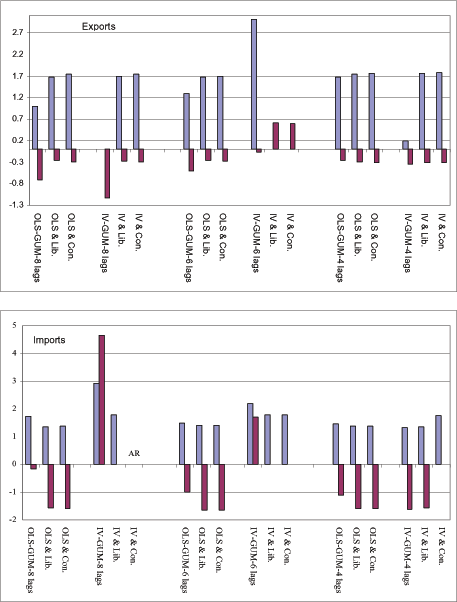
AR: Autoregressive Specification.
GUM: General Unrestricted Model.
Lib: Liberal specification strategy.
Con: Conservative specification strategy.
Table A1: Long-run Income and Price Elasticities for Exports of Aggregate Services - 1987-2001: Alternative Estimation Methods and Automated Specification Algorithms
| Lags | Method | Income | Own-Price | JB | AR | ARCH | SER-GUM (%) | SER-Spec (%) | Par-GUM | Par-Spec | Max Lag in Spec |
|---|---|---|---|---|---|---|---|---|---|---|---|
| 8 | OLS & GUM | 0.99 | -0.70 | Y | Y | Y | 1.50 | 1.50 | 28 | 28 | 8 |
| 8 | OLS & Lib. Search | 1.67* | -0.26* | Y | Y | Y | 1.50 | 1.32 | 28 | 7 | 6 |
| 8 | OLS & Con. Search | 1.74* | -0.29* | Y | Y | Y | 1.50 | 1.51 | 28 | 4 | 6 |
| 8 | IV & GUM | 0.00 | -1.12 | Y | Y | Y | 1.51 | 1.51 | 28 | 28 | 8 |
| 8 | IV & Lib. Search | 1.69* | -1.27* | Y | Y | Y | 1.51 | 1.37 | 28 | 5 | 6 |
| 8 | IV & Con. Search | 1.74* | -0.29* | Y | Y | Y | 1.51 | 1.50 | 28 | 4 | 6 |
| 6 | OLS & GUM | 1.29* | -0.50 | Y | Y | Y | 1.35 | 1.35 | 22 | 22 | 6 |
| 6 | OLS & Lib. Search | 1.67* | -0.26* | Y | Y | Y | 1.35 | 1.32 | 22 | 7 | 6 |
| 6 | OLS & Con. Search | 1.69* | -0.27* | Y | Y | Y | 1.35 | 1.38 | 22 | 5 | 6 |
| 6 | IV & GUM | 3.01 | -0.06 | Y | Y | Y | 2.89 | 2.89 | 22 | 22 | 6 |
| 6 | IV & Lib. Search | 0.00e | +0.61* | Y | Y | Y | 2.89 | 2.44 | 22 | 5 | 6 |
| 6 | IV & Con. Search | 0.00e | +0.59* | Y | Y | Y | 2.89 | 2.46 | 22 | 4 | 1 |
| 4 | OLS & GUM | 1.67* | -0.26* | Y | Y | Y | 1.59 | 1.59 | 16 | 16 | 4 |
| 4 | OLS & Lib. Search | 1.74* | -0.29* | Y | Y | Y | 1.59 | 1.50 | 16 | 5 | 4 |
| 4 | OLS & Con. Search | 1.76* | -0.30* | Y | Y | Y | 1.59 | 1.53 | 16 | 4 | 4 |
| 4 | IV & GUM | 0.20 | -0.34 | Y | Y | Y | 2.29 | 2.29 | 16 | 16 | 4 |
| 4 | IV & Lib. Search | 1.76* | -0.30* | Y | Y | Y | 2.29 | 1.59 | 16 | 4 | 3 |
| 4 | IV & Con. Search | 1.77* | -0.30* | Y | Y | Y | 2.29 | 1.69 | 16 | 4 | 1 |
FIML
| Statistic | VAR lags: 8 | VAR lags: 6 | VAR lags: 4 | VAR lags: 2 |
|---|---|---|---|---|
| Income Elasticity | 1.81* | 3.14* | 1.33* | 1.67* |
| Own-Price Elasticity | -0.17 | +0.56 | -0.37 | -0.23 |
| Loading Coefficient | -0.20 | +0.05 | -0.188 | -0.28* |
| No. Cointegration vectors | 2 | 2 | 1 | 0 |
| JB | Y | Y | Y | Y |
| AR | Y | Y | Y | Y |
| ARCH | Na | Y | Y | Y |
* Statistically significant at the 5 percent level
JB: Jarque-Bera test for normality
AR: Test of Serial independence for the residuals
ARCH: Test of constant
GUM: General Unrestricted Model
SER-GUM: Standard error of the regression associated with the
General Unrestricted Model
SER-Spec: Standard error of the
regression associated with the Specific Model
Par-GUM: Number of parameters in the General Unrestricted Model
Par-Spec: Number of parameters estimated in the Specific Model
Max-Lag in Spec: Maximum lag-length in the Specific Model
Y: One cannot reject the associated null hypothesis
N: One cannot accept the associated null hypothesis
e: Automated specification excludes this variable
Na: Not Applicable because of insufficient degrees of freedom.
Table A2: Long-run Income and Price Elasticities for Imports of Aggregate Services - 1987-2001: Alternative Estimation Methods and Automated Specification Algorithms
| Lags | Method | Income |
Own-Price |
JB |
AR |
ARCH |
SER-GUM (%) |
SER-Spec (%) |
Par-GUM |
Par-Spec |
Max Lag in Spec |
|---|---|---|---|---|---|---|---|---|---|---|---|
| 8 | OLS & GUM | 1.72* |
-0.15 |
Y |
Y |
Y |
1.96 |
1.96 |
28 |
28 |
8 |
| 8 | OLS & Lib. Search | 1.36* |
-1.58* |
Y |
Y |
Y |
1.96 |
1.74 |
28 |
28 |
6 |
| 8 | OLS & Con. Search | 1.37* |
-1.60* |
Y |
Y |
Y |
1.96 |
1.75 |
28 |
28 |
3 |
| 8 | IV & GUM | 2.92 |
+4.64 |
Y |
N |
Y |
2.50 |
2.50 |
28 |
28 |
8 |
| 8 | IV & Lib. Search | 1.78* |
0.00e |
Y |
N |
Y |
2.50 |
1.90 |
28 |
28 |
6 |
| 8 | IV & Con. Search | 0.00e |
0.00e |
Y |
N |
Y |
2.50 |
2.29 |
28 |
28 |
1 |
| 6 | OLS & GUM | 1.49* |
-0.99 |
Y |
N |
Y |
1.83 |
1.83 |
22 |
22 |
6 |
| 6 | OLS & Lib. Search | 1.40* |
-1.65* |
Y |
N |
Y |
1.83 |
1.79 |
22 |
22 |
5 |
| 6 | OLS & Con. Search | 1.40* |
-1.65* |
Y |
Y |
Y |
1.83 |
1.79 |
22 |
22 |
5 |
| 6 | IV & GUM | 2.18 |
+1.71 |
Y |
N |
Y |
2.72 |
2.72 |
22 |
22 |
6 |
| 6 | IV & Lib. Search | 1.78* |
0.00e |
Y |
N |
Y |
2.72 |
1.90 |
22 |
22 |
6 |
| 6 | IV & Con. Search | 1.78* |
0.00e |
Y |
N |
Y |
2.72 |
1.90 |
22 |
22 |
6 |
| 4 | OLS & GUM | 1.47* |
-1.10* |
Y |
Y |
Y |
1.75 |
1.75 |
16 |
16 |
4 |
| 4 | OLS & Lib. Search | 1.37* |
-1.60* |
Y |
Y |
Y |
1.75 |
1.68 |
16 |
16 |
4 |
| 4 | OLS & Con. Search | 1.37* |
-1.60* |
Y |
Y |
Y |
1.75 |
1.75 |
16 |
16 |
3 |
| 4 | IV & GUM | 1.32* |
-1.62 |
Y |
Y |
Y |
1.77 |
1.77 |
16 |
16 |
4 |
| 4 | IV & Lib. Search | 1.36* |
-1.57* |
Y |
Y |
Y |
1.77 |
1.66 |
16 |
16 |
4 |
| 4 | IV & Con. Search | 1.76* |
0.00e |
Y |
Y |
Y |
1.77 |
1.84 |
16 |
16 |
3 |
FIML
| Statistic | VAR lags: 8 |
VAR lags: 6 |
VAR lags: 4 |
VAR lags: 2 |
|---|---|---|---|---|
| Income Elasticity | 3.14* |
3.47* |
2.07* |
1.55* |
| Own-Price Elasticity | +5.25* |
+6.96* |
+1.23 |
-0.92* |
| Loading Coefficient | -0.22* |
-0.13* |
-0.35* |
-0.27* |
| No. Cointegration vectors | 0 |
0 |
1 |
1 |
| JB | Y |
Y |
Y |
Y |
| AR | Y |
Y |
Y |
N |
| ARCH | Na |
Y |
Y |
Y |
* Statistically significant at the 5 percent level
JB: Jarque-Bera test for normality
AR: Test of Serial independence for the residuals
ARCH: Test of constant
GUM: General Unrestricted Model
SER-GUM: Standard error of the regression associated with the
General Unrestricted Model
SER-Spec: Standard error of the
regression associated with the Specific Model
Par-GUM: Number of parameters in the General Unrestricted Model
Par-Spec: Number of parameters estimated in the Specific Model
Max-Lag in Spec: Maximum lag-length in the Specific Model
Y: One cannot reject the associated null hypothesis
N: One cannot accept the associated null hypothesis
e: Automated specification excludes this variable
Na: Not Applicable because of insufficient degrees of freedom.
B Other Private
Exports: Automated search matters in every instance except OLS with eight lags (figure A2, top panel; table A3). Specifically, the only instances of negative price elasticities involve combining instrumental variables and automated search: without these two features, the results do not support the conventional imperfect substitute model. Finally, the choice of search strategy matters a lot. Specifically, there are three instances in which the best-fitting model is an autoregressive formulation; each of these instances stems from relying on a conservative search strategy.
Imports: Automated search matters for every configuration of estimation method and lag length; the choice of automated specification strategy is less relevant (figure A2 bottom; table A4). For example, the IV estimate of the price elasticity with 8 lags and no search is positive whereas reliance on automated search yields a negative price elasticity. Simultaneity also matters: price elasticities based on OLS are much smaller (in absolute value) than the corresponding IV estimates.
Figure A2: Long-run Income and Price Elasticities for Exports and Imports of Other Private Services - 1987-2001: Alternative Estimation Methods and Automated Specification Algorithms
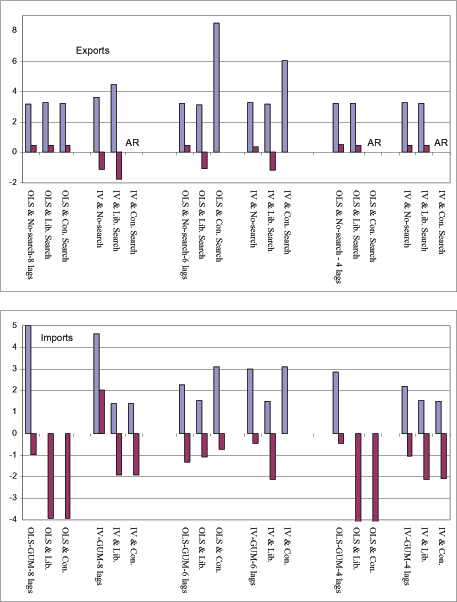
AR: Autoregressive Specification
GUM: General Unrestricted Model
Lib: Liberal specification strategy
Con: Conservative specification strategy
Table A3: Long-run Income and Price Elasticities for Exports of Other Private Services - 1987-2001: Alternative Estimation Methods and Automated Specification Algorithms
| Lags | Method | Income |
Own-Price |
JB |
AR |
ARCH |
SER-GUM (%) |
SER-Spec (%) |
Par-GUM |
Par-Spec |
Max Lag in Spec |
|---|---|---|---|---|---|---|---|---|---|---|---|
| 8 | OLS & GUM | 3.18* |
+0.49 |
Y |
Y |
Y |
1.76 |
1.76 |
27 |
27 |
8 |
| 8 | OLS & Lib. Search | 3.28* |
+0.47* |
Y |
Y |
Y |
1.76 |
1.54 |
27 |
10 |
6 |
| 8 | OLS & Con. Search | 3.25* |
+0.46* |
Y |
Y |
Y |
1.76 |
1.78 |
27 |
5 |
5 |
| 8 | IV & GUM | 3.60 |
-1.12 |
Y |
Y |
Y |
2.37 |
2.37 |
27 |
27 |
8 |
| 8 | IV & Lib. Search | 4.48 |
-1.73 |
Y |
Y |
Y |
2.37 |
1.87 |
27 |
9 |
7 |
| 8 | IV & Con. Search | 0.00e |
0.00e |
Y |
Y |
Y |
2.37 |
1.98 |
27 |
1 |
1 |
| 6 | OLS & GUM | 3.23* |
+0.48 |
Y |
Y |
Y |
1.64 |
1.64 |
21 |
21 |
6 |
| 6 | OLS & Lib. Search | 3.12* |
-1.08* |
Y |
Y |
Y |
1.64 |
1.47 |
21 |
11 |
6 |
| 6 | OLS & Con. Search | 8.50 |
0.00e |
Y |
Y |
Y |
1.64 |
1.69 |
21 |
6 |
5 |
| 6 | IV & GUM | 3.26* |
+0.35 |
Y |
Y |
Y |
1.86 |
1.86 |
21 |
21 |
6 |
| 6 | IV & Lib. Search | 3.20* |
-1.14* |
Y |
Y |
Y |
1.86 |
1.53 |
21 |
11 |
6 |
| 6 | IV & Con. Search | 6.03 |
0.00e |
Y |
Y |
Y |
1.86 |
1.69 |
21 |
6 |
5 |
| 4 | OLS & GUM | 3.23* |
+0.54* |
Y |
Y |
Y |
1.84 |
1.84 |
15 |
15 |
4 |
| 4 | OLS & Lib. Search | 3.25* |
+0.48* |
Y |
Y |
Y |
1.84 |
1.74 |
15 |
7 |
4 |
| 4 | OLS & Con. Search | 0.00e |
0.00e |
Y |
Y |
Y |
1.84 |
1.98 |
15 |
1 |
1 |
| 4 | IV & GUM | 3.27* |
+0.49* |
Y |
Y |
Y |
2.32 |
2.32 |
15 |
15 |
4 |
| 4 | IV & Lib. Search | 3.22* |
+0.48* |
Y |
Y |
Y |
2.32 |
1.93 |
15 |
5 |
1 |
| 4 | IV & Con. Search | 0.00e |
0.00e |
Y |
Y |
Y |
2.32 |
1.98 |
15 |
1 |
1 |
FIML
| Statistic | VAR lags: 8 |
VAR lags: 6 |
VAR lags: 4 |
VAR lags: 2 |
|---|---|---|---|---|
| Income Elasticity | 4.09* |
3.79* |
2.57* |
0.68 |
| Own-Price Elasticity | -1.72 |
-1.52* |
-0.75* |
+0.35 |
| Loading Coefficient | 0.01 |
0.01 |
-0.03* |
0.00 |
| No. Cointegration vectors | 2 |
1 |
0 |
0 |
| JB | Y |
Y |
Y |
Y |
| AR | Y |
Y |
Y |
Y |
| ARCH | Na |
Y |
Y |
Y |
* Statistically significant at the 5 percent level
JB: Jarque-Bera test for normality
AR: Test of Serial independence for the residuals
ARCH: Test of constant
GUM: General Unrestricted Model
SER-GUM: Standard error of the regression associated with the
General Unrestricted Model
SER-Spec: Standard error of the
regression associated with the Specific Model
Par-GUM: Number of parameters in the General Unrestricted Model
Par-Spec: Number of parameters estimated in the Specific Model
Max-Lag in Spec: Maximum lag-length in the Specific Model
Y: One cannot reject the associated null hypothesis
N: One cannot accept the associated null hypothesis
e: Automated specification excludes this variable
Na: Not Applicable because of insufficient degrees of freedom.
Table A4: Long-run Income and Price Elasticities for Imports of Other Private Services - 1987-2001: Alternative Estimation Methods and Automated Specification Algorithms
| Lags | Method | Income |
Own-Price |
JB |
AR |
ARCH |
SER-GUM (%) |
SER-Spec (%) |
Par-GUM |
Par-Spec |
Max Lag in Spec |
|---|---|---|---|---|---|---|---|---|---|---|---|
| 8 | OLS & GUM | 5.00* |
-0.97 |
Y |
Y |
Y |
4.89 |
4.89 |
28 |
28 |
8 |
| 8 | OLS & Lib. Search | 0.00e |
-3.94* |
Y |
Y |
Y |
4.89 |
4.26 |
28 |
7 |
8 |
| 8 | OLS & Con. Search | 0.00e |
-3.94* |
N |
N |
Y |
4.89 |
4.26 |
28 |
7 |
8 |
| 8 | IV & GUM | 4.63* |
+2.01 |
Y |
Y |
Y |
5.15 |
5.15 |
28 |
28 |
8 |
| 8 | IV & Lib. Search | 1.39* |
-1.91* |
Y |
Y |
Y |
5.15 |
4.10 |
28 |
7 |
8 |
| 8 | IV & Con. Search | 1.39* |
-1.91* |
Y |
Y |
Y |
5.15 |
4.10 |
28 |
7 |
8 |
| 6 | OLS & GUM | 2.26 |
-1.31 |
Y |
Y |
Y |
4.79 |
4.79 |
22 |
22 |
6 |
| 6 | OLS & Lib. Search | 1.54* |
-2.18* |
Y |
Y |
Y |
4.79 |
4.10 |
22 |
6 |
3 |
| 6 | OLS & Con. Search | 3.10* |
0.00e |
N |
Y |
Y |
4.79 |
4.32 |
22 |
4 |
2 |
| 6 | IV & GUM | 2.97 |
-0.46 |
Y |
Y |
Y |
4.86 |
4.86 |
22 |
22 |
6 |
| 6 | IV & Lib. Search | 1.50* |
-2.11* |
Y |
Y |
Y |
4.86 |
4.30 |
22 |
7 |
2 |
| 6 | IV & Con. Search | 3.10 |
0.00e |
Y |
Y |
Y |
4.86 |
4.32 |
22 |
4 |
2 |
| 4 | OLS & GUM | 2.86* |
-0.47 |
Y |
Y |
Y |
4.44 |
4.44 |
16 |
16 |
4 |
| 4 | OLS & Lib. Search | 0.00e |
-4.12* |
Y |
N |
Y |
4.44 |
4.22 |
16 |
7 |
4 |
| 4 | OLS & Con. Search | 0.00e |
-4.12* |
Y |
N |
Y |
4.44 |
4.22 |
16 |
7 |
4 |
| 4 | IV & GUM | 2.18 |
-1.06 |
Y |
Y |
Y |
5.13 |
5.13 |
16 |
16 |
4 |
| 4 | IV & Lib. Search | 1.52* |
-2.14* |
Y |
Y |
Y |
5.13 |
4.07 |
16 |
7 |
4 |
| 4 | IV & Con. Search | 1.49* |
-2.10* |
Y |
Y |
Y |
5.13 |
4.30 |
16 |
4 |
3 |
FIML
| Statistic | VAR lags: 8 |
VAR lags: 6 |
VAR lags: 4 |
VAR lags: 3 |
VAR lags: 2 |
|---|---|---|---|---|---|
| Income Elasticity | 1.09 |
0.66 |
1.73* |
1.70* |
1.74* |
| Own-Price Elasticity | -1.56 |
-0.74 |
-2.51* |
-2.45* |
-2.51* |
| Loading Coefficient | 0.03 |
0.03 |
-0.18 |
-0.20* |
-0.12* |
| No. Cointegration vectors | 0 |
2 |
2 |
1 |
2 |
| JB | N |
N |
N |
N |
N |
| AR | Y |
Y |
Y |
Y |
Y |
| ARCH | Na |
Y |
Y |
Y |
Y |
* Statistically significant at the 5 percent level
JB: Jarque-Bera test for normality
AR: Test of Serial independence for the residuals
ARCH: Test of constant
GUM: General Unrestricted Model
SER-GUM: Standard error of the regression associated with the
General Unrestricted Model
SER-Spec: Standard error of the
regression associated with the Specific Model
Par-GUM: Number of parameters in the General Unrestricted Model
Par-Spec: Number of parameters estimated in the Specific Model
Max-Lag in Spec: Maximum lag-length in the Specific Model
Y: One cannot reject the associated null hypothesis
N: One cannot accept the associated null hypothesis
e: Automated specification excludes this variable
Na: Not Applicable because of insufficient degrees of freedom.
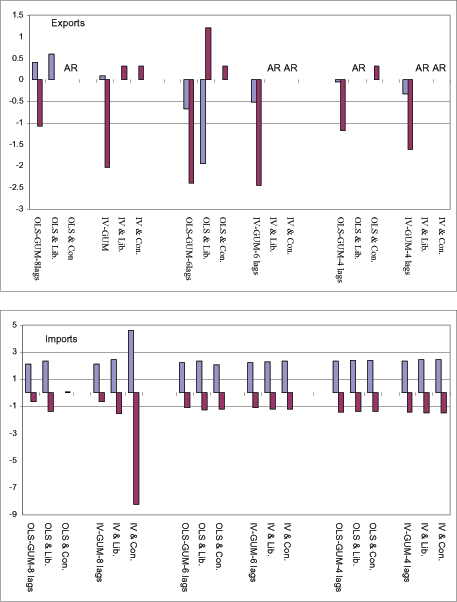
C Fares
Exports: Changes in lag lengths, estimation methods, and automated specification strategies do not yield elasticity estimates helpful to predicting external imbalances in terms of movements in income and relative prices (figure A3 top; table A5). Specifically, for one-third of the final specifications, automated search algorithms suggest that the best model for export fares is an autoregressive formulation. The sole exception to this pattern is the specification using 8 lags with no search. For this case, the income elasticity is a little less than a half and the price elasticity is about minus one.
Imports: For specifications using less than eight lags, the estimated income and price elasticities show a narrow range of variation across estimation methods and search strategies: simultaneity biases are small and reliance on automated search makes little difference for inference (figure A3 bottom; table A6). For eight lags, however, changes in either the choice of strategy or the estimation method have large effects on the point estimates.
Figure A3: Long-run Income and Price Elasticities for Aggregate Exports and Imports of Fare Services - 1987-2001: Alternative Estimation Methods and Automated Specification Algorithms
AR: Autoregressive Specification
GUM: General Unrestricted Model
Lib: Liberal specification strategy
Con: Conservative specification strategy
Table A5: Long-run Income and Price Elasticities for Exports of Fares - 1987-2001: Alternative Estimation Methods and Automated Specification Algorithms
| Lags | Method | Income |
Own-Price |
JB |
AR |
ARCH |
SER-GUM (%) |
SER-Spec (%) |
Par-GUM |
Par-Spec |
Max Lag in Spec |
|---|---|---|---|---|---|---|---|---|---|---|---|
| 8 | OLS & GUM | 0.40 |
-1.07 |
Y |
Y |
Y |
5.31 |
5.31 |
28 |
28 |
8 |
| 8 | OLS & Lib. Search | 0.59 |
0.01 |
Y |
Y |
Y |
5.31 |
4.47 |
28 |
9 |
8 |
| 8 | OLS & Con. Search | 0.00e |
0.00e |
Y |
Y |
Y |
5.31 |
5.07 |
28 |
3 |
1 |
| 8 | IV & GUM | 0.10 |
-2.02* |
Y |
Y |
Y |
7.85 |
7.85 |
28 |
28 |
8 |
| 8 | IV & Lib. Search | 0.00e |
0.32* |
Y |
Y |
Y |
7.85 |
7.10 |
28 |
3 |
6 |
| 8 | IV & Con. Search | 0.00e |
0.32* |
Y |
Y |
Y |
7.85 |
5.10 |
28 |
3 |
6 |
| 6 | OLS & GUM | -0.68 |
-2.39 |
Y |
Y |
Y |
4.98 |
4.98 |
22 |
22 |
6 |
| 6 | OLS & Lib. Search | -1.94 |
1.2 |
Y |
Y |
N |
4.98 |
4.81 |
22 |
7 |
6 |
| 6 | OLS & Con. Search | 0.00e |
+0.32* |
Y |
Y |
Y |
4.98 |
5.14 |
22 |
3 |
5 |
| 6 | IV & GUM | -0.51 |
-2.45 |
N |
Y |
Y |
6.10 |
6.10 |
22 |
22 |
6 |
| 6 | IV & Lib. Search | 0.00e |
00.0e |
N |
Y |
Y |
6.10 |
4.95 |
22 |
4 |
2 |
| 6 | IV & Con. Search | 0.00e |
0.00e |
N |
Y |
Y |
6.10 |
5.14 |
22 |
3 |
1 |
| 4 | OLS & GUM | -0.04 |
-1.18 |
Y |
Y |
Y |
5.12 |
5.12 |
16 |
16 |
4 |
| 4 | OLS & Lib. Search | 0.00e |
0.00e |
Y |
Y |
Y |
5.12 |
4.95 |
16 |
4 |
2 |
| 4 | OLS & Con. Search | 0.00e |
+0.32* |
Y |
Y |
Y |
5.12 |
5.14 |
16 |
3 |
1 |
| 4 | IV & GUM | -0.33 |
-1.61 |
N |
Y |
Y |
6.16 |
6.16 |
16 |
16 |
4 |
| 4 | IV & Lib. Search | 0.00e |
0.00e |
N |
Y |
Y |
6.16 |
4.95 |
16 |
4 |
2 |
| 4 | IV & Con. Search | 0.00e |
0.00e |
N |
Y |
Y |
6.16 |
5.07 |
16 |
3 |
1 |
FIML
| Statistic | VAR lags: 8 |
VAR lags: 6 |
VAR lags: 4 |
VAR lags: 2 |
|---|---|---|---|---|
| Income Elasticity | 0.51 |
1.11* |
2.76 |
1.88 |
| Own-Price Elasticity | -2.10* |
-1.43* |
-2.03* |
-2.29* |
| Loading Coefficient | -0.09 |
0.01 |
0.10 |
0.04 |
| No. Cointegration vectors | 1 |
1 |
0 |
0 |
| JB | Y |
Y |
N |
N |
| AR | Y |
Y |
Y |
Y |
| ARCH | Na |
Y |
Y |
Y |
* Statistically significant at the 5 percent level
JB: Jarque-Bera test for normality
AR: Test of Serial independence for the residuals
ARCH: Test of constant
GUM: General Unrestricted Model
SER-GUM: Standard error of the regression associated with the
General Unrestricted Model
SER-Spec: Standard error of the
regression associated with the Specific Model
Par-GUM: Number of parameters in the General Unrestricted Model
Par-Spec: Number of parameters estimated in the Specific Model
Max-Lag in Spec: Maximum lag-length in the Specific Model
Y: One cannot reject the associated null hypothesis
N: One cannot accept the associated null hypothesis
e: Automated specification excludes this variable
Na: Not Applicable because of insufficient degrees of freedom.
Table A6: Long-run Income and Price Elasticities for Imports of Fares - 1987-2001: Alternative Estimation Methods and Automated Specification Algorithms
| Lags | Method | Income |
Own-Price |
JB |
AR |
ARCH |
SER-GUM (%) |
SER-Spec (%) |
Par-GUM |
Par-Spec |
Max Lag in Spec |
|---|---|---|---|---|---|---|---|---|---|---|---|
| 8 | OLS & GUM | 2.12* |
-0.62* |
Y |
Y |
Y |
3.46 |
3.46 |
29 |
29 |
8 |
| 8 | OLS & Lib. Search | 2.36* |
-1.37* |
Y |
Y |
Y |
3.46 |
3.00 |
29 |
9 |
7 |
| 8 | OLS & Con. Search | 0.00e |
0.05 |
Y |
Y |
Y |
3.46 |
3.30 |
29 |
7 |
7 |
| 8 | IV & GUM | 2.12* |
-0.62 |
Y |
Y |
Y |
3.46 |
3.46 |
29 |
29 |
8 |
| 8 | IV & Lib. Search | 2.47* |
-1.53* |
Y |
Y |
Y |
3.46 |
2.99 |
29 |
10 |
7 |
| 8 | IV & Con. Search | 4.59* |
-8.22* |
Y |
Y |
Y |
3.46 |
3.53 |
29 |
5 |
5 |
| 6 | OLS & GUM | 2.23* |
-1.06* |
Y |
Y |
Y |
3.41 |
3.41 |
23 |
23 |
6 |
| 6 | OLS & Lib. Search | 2.36* |
-1.28* |
Y |
Y |
Y |
3.41 |
3.18 |
23 |
8 |
5 |
| 6 | OLS & Con. Search | 2.08* |
-1.20* |
Y |
Y |
Y |
3.41 |
3.49 |
23 |
6 |
6 |
| 6 | IV & GUM | 2.23* |
-1.06* |
Y |
Y |
Y |
3.41 |
3.41 |
23 |
23 |
6 |
| 6 | IV & Lib. Search | 2.29* |
-1.22* |
Y |
Y |
Y |
3.41 |
3.10 |
23 |
10 |
6 |
| 6 | IV & Con. Search | 2.33* |
-1.22* |
Y |
Y |
Y |
3.41 |
3.94 |
23 |
4 |
1 |
| 4 | OLS & GUM | 2.37* |
-1.43* |
Y |
Y |
Y |
3.39 |
3.39 |
17 |
17 |
4 |
| 4 | OLS & Lib. Search | 2.38* |
-1.38* |
Y |
Y |
Y |
3.39 |
3.19 |
17 |
7 |
4 |
| 4 | OLS & Con. Search | 2.38* |
-1.38* |
Y |
Y |
Y |
3.39 |
3.19 |
17 |
7 |
4 |
| 4 | IV & GUM | 2.37* |
-1.43* |
Y |
Y |
N |
3.39 |
3.39 |
17 |
17 |
4 |
| 4 | IV & Lib. Search | 2.46* |
-1.49* |
Y |
Y |
Y |
3.39 |
3.21 |
17 |
8 |
4 |
| 4 | IV & Con. Search | 2.45* |
-1.49* |
Y |
Y |
Y |
3.39 |
3.21 |
17 |
8 |
4 |
FIML
| Statistic | VAR lags: 8 |
VAR lags: 6 |
VAR lags: 4 |
VAR lags: 2 |
|---|---|---|---|---|
| Income Elasticity | 0.93* |
2.11* |
2.93* |
-0.12 |
| Own-Price Elasticity | +1.10 |
-0.92* |
-2.45* |
+3.31* |
| Loading Coefficient | 0.09 |
-0.28* |
-0.28* |
0.02 |
| No. Cointegration vectors | 2 |
1 |
2 |
2 |
| JB | Y |
Y |
Y |
Y |
| AR | Y |
N |
Y |
Y |
| ARCH | Na |
Y |
Y |
Y |
* Statistically significant at the 5 percent level
JB: Jarque-Bera test for normality
AR: Test of Serial independence for the residuals
ARCH: Test of constant
GUM: General Unrestricted Model
SER-GUM: Standard error of the regression associated with the
General Unrestricted Model
SER-Spec: Standard error of the
regression associated with the Specific Model
Par-GUM: Number of parameters in the General Unrestricted Model
Par-Spec: Number of parameters estimated in the Specific Model
Max-Lag in Spec: Maximum lag-length in the Specific Model
Y: One cannot reject the associated null hypothesis
N: One cannot accept the associated null hypothesis
e: Automated specification excludes this variable
Na: Not Applicable because of insufficient degrees of freedom.
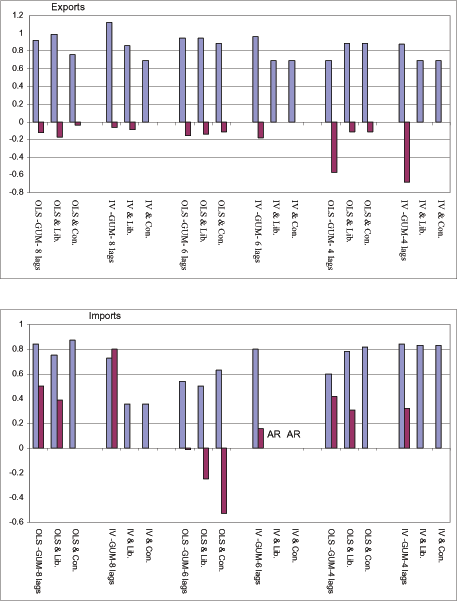
D Transportation
Exports: The estimates are largely invariant to changes in lag lengths or in estimation methods (figure A4 top; table A7). However, changes in the search strategy have sizeable effects on the price elasticity, regardless of whether one uses OLS or instrumental variables. For example, the OLS estimate of the price elasticity based on 4 lags and no search is -0.6 (insignificant) whereas reliance on a conservative automated search lowers the price elasticity to -0.11 but makes it statistically significant.
Imports: Estimates of the price inelasticity are particularly sensitive to changes in design (figure A4 bottom; table A8). For example, the only case of a negative price elasticity is the case of six lags with OLS and automated specification search. Again, in the absence of such automated search, the inference would be that the United States does not have suitable substitutes for foreign transportation services.
Figure A4: Long-run Income and Price Elasticities for Aggregate Exports and Imports of Transportation Services - 1987-2001: Alternative Estimation Methods and Automated Specification Algorithms
AR: Autoregressive Specification
GUM: General Unrestricted Model
Lib: Liberal specification strategy
Con: Conservative specification strategy
Table A8: Long-run Income and Price Elasticities for Exports of Transportation- 1987-2001: Alternative Estimation Methods and Automated Specification Algorithms
| Lags | Method | Income |
Own-Price |
JB |
AR |
ARCH |
SER-GUM (%) |
SER-Spec (%) |
Par-GUM |
Par-Spec |
Max Lag in Spec |
|---|---|---|---|---|---|---|---|---|---|---|---|
| 8 | OLS & GUM | 0.92* |
-0.12 |
Y |
Y |
Y |
2.24 |
2.24 |
28 |
28 |
8 |
| 8 | OLS & Lib. Search | 0.99* |
-0.17* |
Y |
Y |
Y |
2.24 |
2.08 |
28 |
11 |
8 |
| 8 | OLS & Con. Search | 0.76* |
-0.04 |
Y |
Y |
Y |
2.24 |
2.19 |
28 |
8 |
7 |
| 8 | IV & GUM | 1.12* |
-0.06 |
Y |
Y |
Y |
2.78 |
2.78 |
28 |
28 |
8 |
| 8 | IV & Lib. Search | 0.86* |
-0.09* |
Y |
Y |
Y |
2.78 |
2.33 |
28 |
8 |
8 |
| 8 | IV & Con. Search | 0.69* |
0.00e |
Y |
Y |
Y |
2.78 |
2.84 |
28 |
3 |
2 |
| 6 | OLS & GUM | 0.95* |
-0.16 |
Y |
Y |
Y |
2.31 |
2.31 |
22 |
22 |
6 |
| 6 | OLS & Lib. Search | 0.95* |
-0.14 |
Y |
Y |
Y |
2.31 |
2.21 |
22 |
10 |
6 |
| 6 | OLS & Con. Search | 0.89* |
-0.11 |
Y |
Y |
Y |
2.31 |
2.41 |
22 |
7 |
4 |
| 6 | IV & GUM | 0.96* |
-0.18 |
Y |
Y |
Y |
2.32 |
2.32 |
22 |
22 |
6 |
| 6 | IV & Lib. Search | 0.69* |
0.00e |
Y |
Y |
Y |
2.32 |
2.63 |
22 |
5 |
4 |
| 6 | IV & Con. Search | 0.69* |
0.00e |
Y |
Y |
Y |
2.32 |
2.63 |
22 |
5 |
4 |
| 4 | OLS & GUM | 0.69* |
-0.57 |
Y |
Y |
Y |
2.44 |
2.44 |
16 |
16 |
4 |
| 4 | OLS & Lib. Search | 0.89* |
-0.11 |
Y |
Y |
Y |
2.44 |
2.41 |
16 |
7 |
4 |
| 4 | OLS & Con. Search | 0.89* |
-0.11 |
Y |
Y |
Y |
2.44 |
2.41 |
16 |
7 |
4 |
| 4 | IV & GUM | 0.88 |
-0.68 |
Y |
Y |
Y |
2.62 |
2.62 |
16 |
16 |
4 |
| 4 | IV & Lib. Search | 0.69* |
0.00e |
Y |
Y |
Y |
2.62 |
2.62 |
16 |
5 |
4 |
| 4 | IV & Con. Search | 0.69* |
0.00e |
Y |
Y |
Y |
2.62 |
2.79 |
16 |
3 |
2 |
FIML
| Statistic | VAR lags: 8 |
VAR lags: 6 |
VAR lags: 4 |
VAR lags: 2 |
|---|---|---|---|---|
| Income Elasticity | 1.05* |
1.08* |
0.95* |
0.85* |
| Own-Price Elasticity | -0.10 |
-0.28 |
-0.53* |
-0.04 |
| Loading Coefficient | 0.04 |
-0.07 |
-0.09* |
-0.16* |
| No. Cointegration vectors | 1 |
1 |
1 |
1 |
| JB | Y |
Y |
Y |
Y |
| AR | Y |
Y |
Y |
Y |
| ARCH | Na |
Y |
Y |
Y |
* Statistically significant at the 5 percent level
JB: Jarque-Bera test for normality
AR: Test of Serial independence for the residuals
ARCH: Test of constant
GUM: General Unrestricted Model
SER-GUM: Standard error of the regression associated with the
General Unrestricted Model
SER-Spec: Standard error of the
regression associated with the Specific Model
Par-GUM: Number of parameters in the General Unrestricted Model
Par-Spec: Number of parameters estimated in the Specific Model
Max-Lag in Spec: Maximum lag-length in the Specific Model
Y: One cannot reject the associated null hypothesis
N: One cannot accept the associated null hypothesis
e: Automated specification excludes this variable
Na: Not Applicable because of insufficient degrees of freedom.
Table A8: Long-run Income and Price Elasticities for Imports of Transportation- 1987-2001: Alternative Estimation Methods and Automated Specification Algorithms
| Lags | Method | Income |
Own-Price |
JB |
AR |
ARCH |
SER-GUM (%) |
SER-Spec (%) |
Par-GUM |
Par-Spec |
Max Lag in Spec |
|---|---|---|---|---|---|---|---|---|---|---|---|
| 8 | OLS & GUM | 0.84* |
+0.50* |
Y |
Y |
Y |
2.74 |
2.74 |
29 |
29 |
8 |
| 8 | OLS & Lib. Search | 0.79* |
+0.28* |
Y |
Y |
Y |
2.74 |
2.52 |
29 |
6 |
6 |
| 8 | OLS & Con. Search | 0.87* |
0.00e |
Y |
Y |
Y |
2.74 |
2.68 |
29 |
3 |
5 |
| 8 | IV & GUM | 0.73 |
0.80 |
Y |
Y |
Y |
3.04 |
3.04 |
29 |
29 |
8 |
| 8 | IV & Lib. Search | 0.36* |
0.00e |
Y |
Y |
Y |
3.04 |
2.55 |
29 |
3 |
8 |
| 8 | IV & Con. Search | 0.36* |
0.00e |
Y |
Y |
Y |
3.04 |
2.66 |
29 |
3 |
1 |
| 6 | OLS & GUM | 0.54* |
-0.01 |
Y |
Y |
Y |
2.62 |
2.62 |
23 |
23 |
6 |
| 6 | OLS & Lib. Search | 0.50* |
-0.25* |
Y |
Y |
Y |
2.62 |
2.42 |
23 |
7 |
6 |
| 6 | OLS & Con. Search | 0.65* |
-0.53* |
Y |
Y |
Y |
2.62 |
2.68 |
23 |
3 |
5 |
| 6 | IV & GUM | 0.80* |
0.16 |
Y |
Y |
Y |
4.48 |
4.48 |
23 |
23 |
6 |
| 6 | IV & Lib. Search | 0.00e |
0.00e |
Y |
Y |
Y |
4.48 |
2.88 |
23 |
1 |
1 |
| 6 | IV & Con. Search | 0.00e |
0.00e |
Y |
Y |
Y |
4.48 |
2.88 |
23 |
1 |
1 |
| 4 | OLS & GUM | 0.60* |
0.42 |
Y |
Y |
Y |
2.74 |
2.74 |
17 |
17 |
4 |
| 4 | OLS & Lib. Search | 0.78* |
0.31* |
Y |
Y |
Y |
2.74 |
2.53 |
17 |
5 |
1 |
| 4 | OLS & Con. Search | 0.82* |
0.00e |
Y |
Y |
Y |
2.74 |
2.62 |
17 |
3 |
1 |
| 4 | IV & GUM | 0.84* |
0.32 |
Y |
Y |
Y |
3.98 |
3.98 |
17 |
17 |
4 |
| 4 | IV & Lib. Search | 0.83* |
0.00e |
Y |
Y |
Y |
3.98 |
2.65 |
17 |
3 |
2 |
| 4 | IV & Con. Search | 0.83* |
0.00e |
Y |
Y |
Y |
3.98 |
2.65 |
17 |
3 |
2 |
FIML
| Statistic | VAR lags: 8 |
VAR lags: 6 |
VAR lags: 4 |
VAR lags: 2 |
|---|---|---|---|---|
| Income Elasticity | -0.37 |
0.87* |
0.91* |
0.91* |
| Own-Price Elasticity | +2.45 |
+0.20 |
+0.30 |
-0.14 |
| Loading Coefficient | -0.06* |
-0.32 |
-0.19 |
-0.10 |
| No. Cointegration vectors | 2 |
0 |
0 |
1 |
| JB | Y |
Y |
Y |
N |
| AR | N |
Y |
Y |
Y |
| ARCH | Na |
Y |
Y |
Y |
* Statistically significant at the 5 percent level
JB: Jarque-Bera test for normality
AR: Test of Serial independence for the residuals
ARCH: Test of constant
GUM: General Unrestricted Model
SER-GUM: Standard error of the regression associated with the
General Unrestricted Model
SER-Spec: Standard error of the
regression associated with the Specific Model
Par-GUM: Number of parameters in the General Unrestricted Model
Par-Spec: Number of parameters estimated in the Specific Model
Max-Lag in Spec: Maximum lag-length in the Specific Model
Y: One cannot reject the associated null hypothesis
N: One cannot accept the associated null hypothesis
e: Automated specification excludes this variable
Na: Not Applicable because of insufficient degrees of freedom.
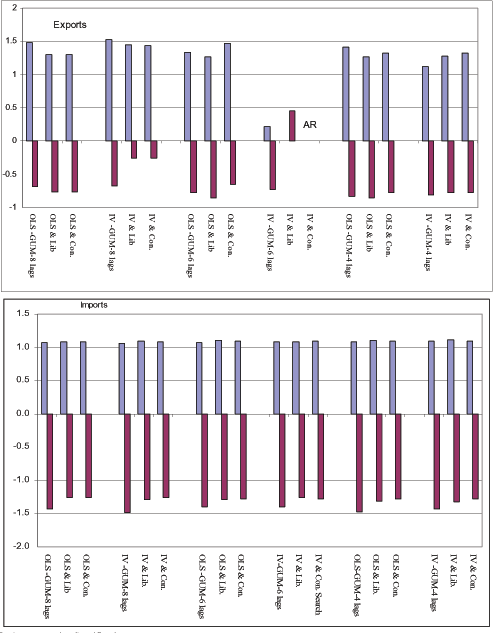
E Travel
Exports: For estimates based on four lags, the estimates show a narrow range of variation across estimation methods and search strategies (figure A5 top; table A9). These results suggest that simultaneity biases are small and that reliance on automated search make little difference for inference. The exception is the case of IV estimation with six lags: reliance on automated search yields either a time-series formulation or one with a positive price elasticity.
Imports: The estimates show a narrow range of variation across the estimation methods, lag lengths, and the search strategies (figure A5 bottom; table A10). This narrow range is the more interesting given that simplification of the general model with eight lags yields a specific formulation also with eight lags.
Figure A5: Long-run Income and Price Elasticities for Aggregate Exports and Imports of Travel Services - 1987-2001: Alternative Estimation Methods and Automated Specification Algorithms
AR: Autoregressive Specification
GUM: General Unrestricted Model
Lib: Liberal specification strategy
Con: Conservative specification strategy
Table A9: Long-run Income and Price Elasticities for Exports of Travel - 1987-2001: Alternative Estimation Methods and Automated Specification Algorithms
| Lags | Method | Income |
Own-Price |
JB |
AR |
ARCH |
SER-GUM (%) |
SER-Spec (%) |
Par-GUM |
Par-Spec |
Max Lag in Spec |
|---|---|---|---|---|---|---|---|---|---|---|---|
| 8 | OLS & GUM | 1.48* |
-0.68* |
Y |
Y |
Y |
4.17 |
4.17 |
27 |
27 |
8 |
| 8 | OLS & Lib. Search | 1.30* |
-0.76* |
Y |
Y |
Y |
4.17 |
3.48 |
27 |
4 |
8 |
| 8 | OLS & Con. Search | 1.30* |
-0.76* |
Y |
Y |
Y |
4.17 |
3.48 |
27 |
4 |
8 |
| 8 | IV & GUM | 1.53* |
-0.67* |
Y |
Y |
Y |
4.19 |
4.19 |
27 |
27 |
8 |
| 8 | IV & Lib. Search | 1.45* |
-0.26* |
Y |
Y |
Y |
4.19 |
3.58 |
27 |
5 |
8 |
| 8 | IV & Con. Search | 1.44* |
-0.26* |
Y |
Y |
Y |
4.19 |
3.58 |
27 |
5 |
8 |
| 6 | OLS & GUM | 1.34* |
-0.78* |
Y |
Y |
Y |
4.00 |
4.00 |
21 |
21 |
6 |
| 6 | OLS & Lib. Search | 1.27* |
-0.85* |
Y |
Y |
Y |
4.00 |
3.66 |
21 |
4 |
4 |
| 6 | OLS & Con. Search | 1.47* |
-0.65* |
Y |
Y |
Y |
4.00 |
3.87 |
21 |
4 |
2 |
| 6 | IV & GUM | 0.22 |
-0.73* |
Y |
Y |
Y |
5.47 |
5.47 |
21 |
21 |
6 |
| 6 | IV & Lib. Search | 0.00e |
+0.46* |
Y |
Y |
Y |
5.47 |
4.85 |
21 |
3 |
2 |
| 6 | IV & Con. Search | 0.00e |
0.00e |
Y |
Y |
Y |
5.47 |
4.35 |
21 |
2 |
2 |
| 4 | OLS & GUM | 1.41* |
-0.83* |
Y |
Y |
Y |
3.85 |
3.85 |
15 |
15 |
4 |
| 4 | OLS & Lib. Search | 1.27* |
-0.85* |
Y |
Y |
Y |
3.85 |
3.66 |
15 |
4 |
4 |
| 4 | OLS & Con. Search | 1.32* |
-0.77* |
Y |
Y |
Y |
3.85 |
3.76 |
15 |
4 |
3 |
| 4 | IV & GUM | 1.12* |
-0.81* |
Y |
Y |
Y |
4.35 |
4.35 |
15 |
15 |
4 |
| 4 | IV & Lib. Search | 1.28* |
-0.78* |
Y |
Y |
Y |
4.35 |
3.65 |
15 |
5 |
3 |
| 4 | IV & Con. Search | 1.32* |
-0.77* |
Y |
Y |
Y |
4.35 |
3.76 |
15 |
4 |
3 |
FIML
| Statistic | VAR lags: 8 |
VAR lags: 6 |
VAR lags: 4 |
VAR lags: 2 |
|---|---|---|---|---|
| Income Elasticity | 1.30* |
1.57* |
1.20* |
0.85* |
| Own-Price Elasticity | -0.77* |
-0.79* |
-0.96* |
-0.76* |
| Loading Coefficient | -0.32* |
-0.20* |
-0.35* |
-0.16 |
| No. Cointegration vectors | 2 |
1 |
0 |
0 |
| JB | Y |
Y |
Y |
Y |
| AR | Y |
Y |
Y |
Y |
| ARCH | Na |
Y |
Y |
Y |
* Statistically significant at the 5 percent level
JB: Jarque-Bera test for normality
AR: Test of Serial independence for the residuals
ARCH: Test of constant
GUM: General Unrestricted Model
SER-GUM: Standard error of the regression associated with the
General Unrestricted Model
SER-Spec: Standard error of the
regression associated with the Specific Model
Par-GUM: Number of parameters in the General Unrestricted Model
Par-Spec: Number of parameters estimated in the Specific Model
Max-Lag in Spec: Maximum lag-length in the Specific Model
Y: One cannot reject the associated null hypothesis
N: One cannot accept the associated null hypothesis
e: Automated specification excludes this variable
Na: Not Applicable because of insufficient degrees of freedom.
Table A10: Long-run Income and Price Elasticities for Imports of Travel - 1987-2001: Alternative Estimation Methods and Automated Specification Algorithms
| Lags | Method | Income |
Own-Price |
JB |
AR |
ARCH |
SER-GUM (%) |
SER-Spec (%) |
Par-GUM |
Par-Spec |
Max Lag in Spec |
|---|---|---|---|---|---|---|---|---|---|---|---|
| 8 | OLS & GUM | 1.07* |
-1.43* |
Y |
Y |
Y |
2.29 |
2.29 |
27 |
27 |
8 |
| 8 | OLS & Lib. Search | 1.08* |
-1.26* |
Y |
Y |
Y |
2.29 |
2.13 |
27 |
7 |
7 |
| 8 | OLS & Con. Search | 1.08* |
-1.26* |
Y |
Y |
Y |
2.29 |
2.22 |
27 |
5 |
7 |
| 8 | IV & GUM | 1.06* |
-1.48* |
Y |
Y |
Y |
2.35 |
2.35 |
27 |
27 |
8 |
| 8 | IV & Lib. Search | 1.09* |
-1.29* |
Y |
Y |
Y |
2.35 |
2.02 |
27 |
11 |
8 |
| 8 | IV & Con. Search | 1.08* |
-1.26* |
Y |
Y |
Y |
2.35 |
2.23 |
27 |
5 |
7 |
| 6 | OLS & GUM | 1.07* |
-1.40* |
Y |
Y |
Y |
2.24 |
2.24 |
21 |
21 |
6 |
| 6 | OLS & Lib. Search | 1.10* |
-1.29* |
Y |
Y |
Y |
2.24 |
2.16 |
21 |
7 |
6 |
| 6 | OLS & Con. Search | 1.09* |
-1.28* |
Y |
Y |
Y |
2.24 |
2.35 |
21 |
4 |
4 |
| 6 | IV & GUM | 1.08* |
-1.40* |
Y |
Y |
Y |
2.28 |
2.28 |
21 |
21 |
6 |
| 6 | IV & Lib. Search | 1.08* |
-1.26* |
Y |
Y |
Y |
2.28 |
2.13 |
21 |
8 |
6 |
| 6 | IV & Con. Search | 1.09* |
-1.28* |
Y |
Y |
Y |
2.28 |
2.35 |
21 |
4 |
4 |
| 4 | OLS & GUM | 1.08* |
-1.47* |
Y |
Y |
Y |
2.41 |
2.41 |
15 |
15 |
4 |
| 4 | OLS & Lib. Search | 1.10* |
-1.31* |
Y |
Y |
Y |
2.41 |
2.30 |
15 |
5 |
4 |
| 4 | OLS & Con. Search | 1.09* |
-1.28* |
Y |
Y |
Y |
2.41 |
2.35 |
15 |
4 |
4 |
| 4 | IV & GUM | 1.09* |
-1.43* |
Y |
Y |
Y |
2.45 |
2.45 |
15 |
15 |
4 |
| 4 | IV & Lib. Search | 1.11* |
-1.32* |
Y |
Y |
Y |
2.45 |
2.28 |
15 |
5 |
4 |
| 4 | IV & Con. Search | 1.09* |
-1.28* |
Y |
Y |
Y |
2.45 |
2.35 |
15 |
4 |
4 |
FIML
| Statistic | VAR lags: 8 |
VAR lags: 6 |
VAR lags: 4 |
VAR lags: 2 |
|---|---|---|---|---|
| Income Elasticity | 1.08* |
1.05* |
1.04* |
0.86* |
| Own-Price Elasticity | -1.63* |
-1.45* |
-1.56* |
-1.98* |
| Loading Coefficient | -0.85* |
-1.19* |
-0.82* |
-0.11 |
| No. Cointegration vectors | 0 |
1 |
1 |
2 |
| JB | Y |
Y |
Y |
Y |
| AR | Y |
Y |
Y |
Y |
| ARCH | Na |
Y |
Y |
Y |
* Statistically significant at the 5 percent level
JB: Jarque-Bera test for normality
AR: Test of Serial independence for the residuals
ARCH: Test of constant
GUM: General Unrestricted Model
SER-GUM: Standard error of the regression associated with the
General Unrestricted Model
SER-Spec: Standard error of the
regression associated with the Specific Model
Par-GUM: Number of parameters in the General Unrestricted Model
Par-Spec: Number of parameters estimated in the Specific Model
Max-Lag in Spec: Maximum lag-length in the Specific Model
Y: One cannot reject the associated null hypothesis
N: One cannot accept the associated null hypothesis
e: Automated specification excludes this variable
Na: Not Applicable because of insufficient degrees of freedom.
Figure A6: Cumulative Lag Distribution for OLS Elasticities of Travel Imports - 6 lags
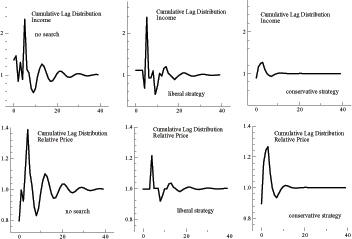
Figure A7: Cumulative Lag Distribution for OLS Elasticities of Travel Imports - 4 lags
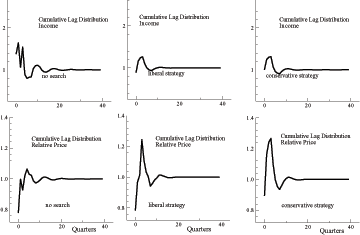
F Aggregation Biases
I compute the aggregate of income elasticities for exports using equation (7); I also compute the corresponding aggregate for the price elasticities. The results indicate that the income elasticity of the aggregate equation is always lower than the aggregate of the income elasticities from the disaggregated equations (figure A8). In other words, aggregation is biasing the income elasticity downwards, though the magnitude and significance of the biases is sensitive to the estimation method: the aggregation bias is significant only for FIML. For the price elasticity, the results indicate that the estimate based on the aggregate equation is significantly lower (in absolute terms) than the estimate based on the aggregation of price elasticities for service-specific categories (figure A9).
To compute the aggregate of income elasticities for imports I use equation (12); I also compute the corresponding aggregate for the price elasticities. The results indicate that the income elasticity of the aggregate equation is higher than the aggregate of the income elasticities from the disaggregated equations (figure A10). In other words, aggregation is biasing the income elasticity upwards. Again, the aggregation bias is significant only for FIML. For the price elasticity, the results indicate that the estimate for aggregate imports is significantly different from the estimate based on the aggregation of service-specific categories (figure A11); the direction of the bias is sensitive to the estimation method.
Figure A8: Aggregation Biases and Estimation Methods: Income Elasticity for Aggregate Exports of Services
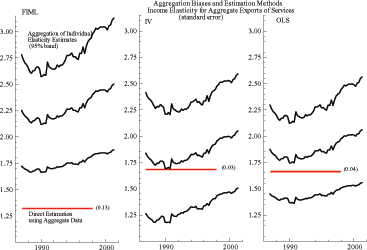
Figure A9: Aggregation Biases and Estimation Methods: Price Elasticity for Aggregate Exports of Services
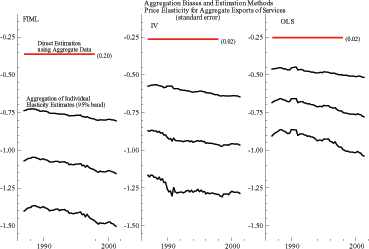
Figure A10: Aggregation Biases and Estimation Methods: Income Elasticity for Aggregate Imports of Services
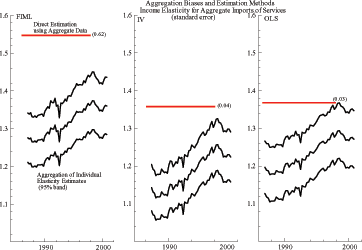
Figure A11: Aggregation Biases and Estimation Methods: Price Elasticity for Aggregate Imports of Services
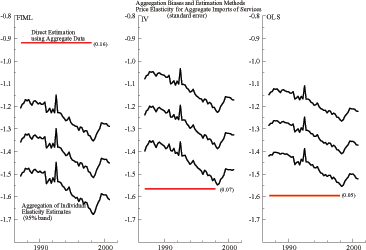
Footnotes
* Corresponding author's e-mail address is [email protected] Previous versions of this paper have been presented at the Federal Reserve Board, George Mason University, Johns Hopkins-SAIS, the 2004 Meetings of the International Economics and Finance Society and of the Midwest International Economics Group, the World Bank, the Woodrow Wilson Center, and the 2005 meetings of the Computer in Economics and Finance Society. I would like to thank Neil Ericsson, Joe Gagnon, Dale Henderson, David Hendry, Cathy Mann, and Trevor Reeve for their detailed comments. The calculations are based on PcGets; see Hendry and Krolzig (2001) and PcGive; see Hendry and Doornik (1999). The views in this paper are solely the responsibility of the authors and should not be interpreted as reflecting the views of the Board of Governors of the Federal Reserve System or of any other person associated with the Federal Reserve System. This paper can be downloaded without charge from Social Science Research Network electronic library at http://www.ssrn.com/ Return to text
1. See Bryant, Holtham, and Hooper (1988), Burger (1989), and Mann (1999, 2004). Return to text
2. The key studies are Reeve(2001); Deardorff et al. (2001); Mann (2004); and Kimura and Lee (2004). Return to text
3. See van Welsum (2003), and Mirza and Nicoletti (2004). Return to text
4. Net exports of goods and net exports of services were quite close to zero from 1930 to 1976. Return to text
5. One cannot reject the hypothesis that 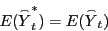 . Return to text
6. This asymmetry was noted first by Houthakker and Magee in 1969; Goldstein and Khan (1985) and Marquez (2002) review the associated literature. Recent papers on this asymmetry were presented at the 2004 ASSA meetings in the session "Income and Price Elasticities in World Trade: 35 Years Later." Return to text
7. The most common formulation in this area is the log-linear one; see Goldstein and Khan (1985) and Marquez (2002). Return to text
8. For a discussion of the issues raised by automated specification, see Hendry and Krolzig (2003), Granger and Hendry (2004), and Phillips (2004). Return to text
9. I use Package version 1.02 of PcGets with its default settings. Return to text
10. There is no guarantee that reliance on these three criteria will yield a unique model. In the event that the application of these criteria yields more than one model, the user specifies a criteria ranking to settle the conflict. In this paper, I use the Akaike Information Criterion. Return to text
11. All of the data for services, both in current and constant prices come from the Survey of Current Business prepared by the Bureau of Economic Analysis (BEA). The data for trade in real terms begin in 1987. The components for Defense and Royalties are excluded as they do not involve arm's length negotiations. These components represent a small share of the aggregate services. Return to text
12. Education: expenditures by foreign students in the United States. Financial services: commissions and transactions fees associated with purchases of U.S. securities. Telecommunications: telephone services, telex, e-mails, management of data networks and satellites' information. Business: receipts for services provided in accounting, auditing, bookkeeping, advertising, computer and data processing, engineering, architectural, legal, consulting, medical services, performing arts, sport events. Other: film and tape rentals, earnings of U.S. residents temporarily employed abroad, expenditures of foreign residents employed temporarily in the United States, expenditures by international organizations in the United States. Return to text
13. 20 OECD countries (including Mexico and South Korea), China, Argentina, Brazil, Chile, Colombia, Venezuela, Hong Kong, India, Indonesia, Malaysia, Philippines, Singapore, Taiwan, Thailand. Return to text
14. For instruments I use the lagged ratio of U.S. claims on foreigners relative to U.S. GDP, the lagged ratio of U.S. liabilities to foreigners to U.S. GDP, the price of domestic services, contemporaneous and lagged; I have not evaluated the results to alternative instruments. For Johansen's procedure, see Johansen (1988). Return to text
15. Release 1.02 of PcGets allows only OLS and IV. For these two estimators, there are 18 specifications for each type of service: three maximum lag-lengths (4, 6, 8), three search strategies (general, liberal, conservative), and two estimators (OLS, IV). Return to text
16. Figures A1-A5 compare estimates across lags, estimation methods, and search strategies; tables A1-A10 indicate whether these specifications exhibit normality, serial independence, and homoskedasticity. These tables include key statistics comparing the general and the specific formulation: standard errors, number of parameters, maximum lag in the specification. Return to text
17. See Hendry and Doornik (1999), page 237 for the formal derivation of the cumulative lag distribution. Return to text
18. Figures A6-A7 in the appendix show the cumulative lag distribution of the cases of six and four lags. Return to text
19. Tables A1-A10 report the cointegration vector, the number of cointegration vectors, the speed of adjustment (loading coefficient), and the test results for the properties of the vector of residuals. Return to text
20. Figures A8-A11 of the appendix compare the aggregate of elasticities to the elasticity of the aggregate and the tests confirm the existence of aggregation biases in income and price elasticities. Return to text
This version is optimized for use by screen readers. Descriptions for all mathematical expressions are provided in LaTex format. A printable pdf version is available. Return to text